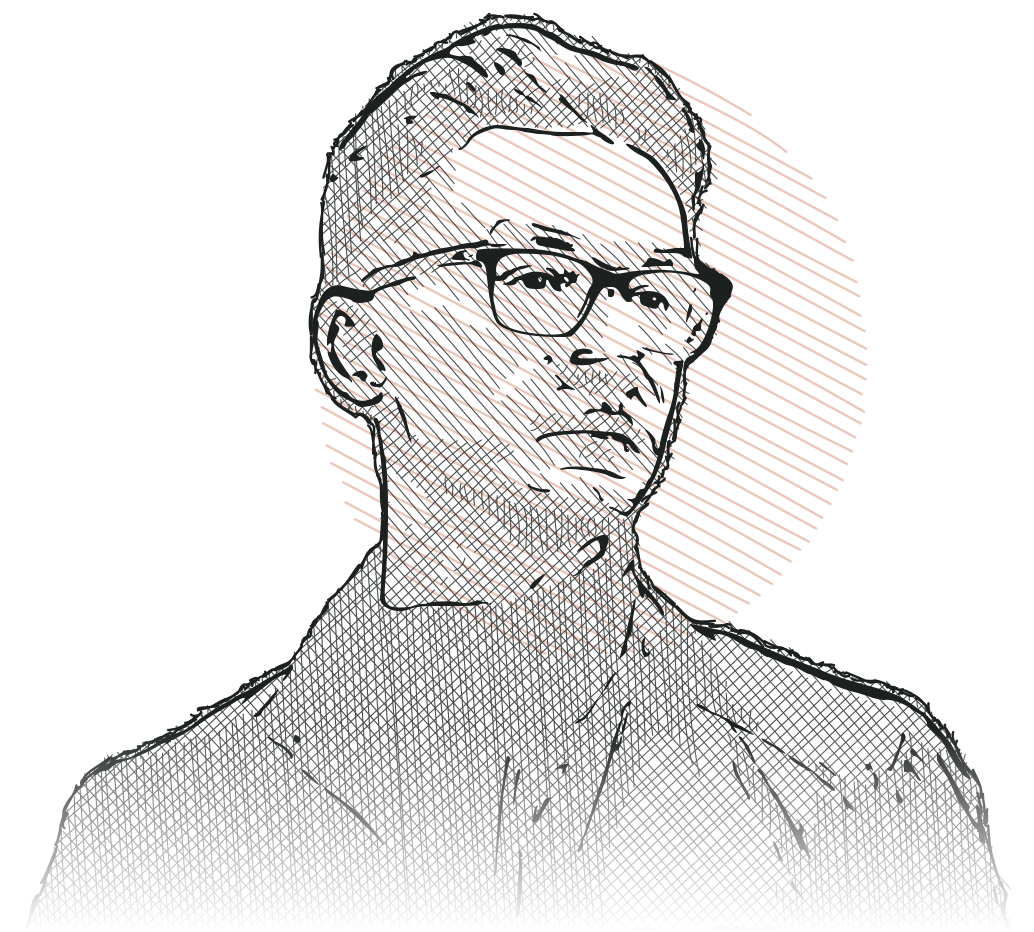
Simas Razinskas

Simas Razinskas · AI developer & consultant

I build AI systems that still work when the demo is over.

Currently: turning AI workflows, agent systems and internal automations into software teams can rely on

Case studies

More case studies

Twelve production systems, written up the way they were built: the problem, the constraint that shaped the design, and how the system behaves when things fail. Clients stay anonymous. The engineering doesn't.

An agent-operated task engine

AI agents needed to work from the same queue as humans without double-claiming tasks or hiding failures. Agents can claim, heartbeat, complete, fail, and escalate work safely while humans watch the same board update in real time.

Read the case study →

Idempotent webhook ingestion at scale

Third-party webhooks retried, duplicated, and arrived out of order; silent loss would only surface later as broken reports. Data-loss risk moved from a quarterly investigation to continuous checks that detect gaps, repair them, and expose operational health.

Read the case study →

Worked across

  • Fintech
  • AI & media
  • Automation & ops
  • Developer tooling
  • Geospatial
  • SaaS

Most of this shipped under NDA — so it's described by what it does, with public work to back it up.

What I've built

  • LLM media-localization pipelines

    End-to-end translation and adaptation of video, audio and image content — transcription, machine translation, voice synthesis and on-image text replacement, wired together to run at scale.

  • Multi-service automation platforms

    Monorepos stitching dashboards, queues, APIs and third-party integrations into the daily operational workflow of marketing and ops teams.

  • Agentic AI tooling & assistants

    Retrieval-augmented helpdesk assistants, automated ticket triage and internal copilots — LLMs put to work against real business data and processes.

  • Browser & design-tool plugins

    Figma plugins and Adobe scripting for design automation, plus Chrome extensions that fold internal tooling directly into the browser.

  • Web apps: CRM, commerce & learning

    Customer and credit management systems, storefronts and learning platforms — typed full-stack apps on Next.js with Postgres behind them.

  • Geospatial & mapping applications

    Interactive map products over OpenLayers and GeoServer, including EV-charging location and routing data through open standards.

  • Mobile & native desktop apps

    Cross-platform apps with React Native / Expo, native mobile work, and a native macOS utility in Swift.

  • Developer tooling & deploy infra

    CLIs and self-hosted delivery pipelines — including the agent-operated platform that runs this very domain.

160+
repositories built
8+
languages shipped to production
12+
years writing code
self-hosted
production infrastructure I own end-to-end

Problems I've solved

Twelve case studies, anonymized down to the engineering: what broke, what constrained the fix, and what shipped. AI pipelines, distributed systems, infrastructure.

Read the case studies →

  • Zero-downtime blue-green deploys with health-gated rollback

    Build-once / promote-only images, staging-tested with live migrations, then swapped atomically behind a reverse proxy. A container health gate decides each release: pass drains the old color, fail rolls back automatically with the old version still serving. Pre-migration database snapshots and expand/contract migrations make even schema changes reversible.

    Docker Compose · Traefik · Postgres · shell orchestration
  • Agent-operated task engine

    A distributed kanban where autonomous agents claim work via FOR UPDATE SKIP LOCKED under renewable leases, with a lazy TTL sweeper (no background worker), three-strike escalation to a human, and an append-only event log. Boards sync in real time over Postgres LISTEN/NOTIFY fanned out as server-sent events.

    Drizzle · Postgres LISTEN/NOTIFY · SSE · contract-first API
  • Idempotent webhook ingestion at scale

    A durable Postgres-backed queue accepting third-party webhooks with at-most-once delivery via upserts keyed on external IDs. Three self-healing layers guard against silent data loss: dual-trigger reconciliation, missing-ID backfill detection with tombstone anti-joins, and 30+ automated anomaly checks on latency and orphaned records.

    Go · Postgres (SKIP LOCKED, matviews) · HMAC · advisory locks
  • Database-backed job queue replacing no-code workflows

    Replaced a stack of brittle no-code automations with a hand-rolled durable queue: lease columns, claim counts and heartbeats dispatching rate-limited jobs to external APIs, child idempotency keys for mid-flight recovery, and shadow / dry-run modes for testing safely in parallel with production.

    Go · Postgres leases · gocron · bearer + HMAC auth
  • Frame-accurate video localization

    An end-to-end dubbing pipeline: transcription with speaker diarization and word-level forced alignment, neural voice cloning, and per-segment audio time-stretching so synthesized speech matches the original timing without drift across multi-minute media — with vocal/instrumental separation to keep backing audio clean.

    WhisperX · XTTS voice cloning · Demucs · FFmpeg · CTranslate2
  • Round-trip translation of structured design documents

    Extracting and re-injecting text across 3,000+ segments inside packaged document formats (nested ZIP/XML trees) while preserving exact element indices, inline formatting and layout — surviving a full export → translate → reimport round trip without corrupting structure.

    Python XML/ZIP tooling · multi-format CAT interchange
  • Evolutionary prompt optimization

    Discovering better translation prompts with a genetic algorithm — elitism, adaptive per-mutation weights, crossover and diversity maintenance — scored by a learned semantic-similarity metric under a multi-objective fitness function balancing quality, length and vocabulary.

    BLEURT · LLM APIs · evolutionary operators · NumPy
  • Serverless GPU inference orchestration

    Driving multi-minute image-generation workflows on serverless GPUs over WebSockets: enqueue, poll, stream large binary outputs, and recover job state across mid-inference network drops with bounded exponential backoff and clean worker teardown to prevent VRAM leaks.

    RunPod · ComfyUI · WebSockets · S3 offload
  • Multi-provider AI gateway with cost accounting

    Routing generation requests across many model providers behind one uniform adapter interface, with per-model concurrency limits, automatic failover, and session / daily / total cost aggregation — exposed over both async REST and streaming gRPC.

    Go adapters · gRPC / protobuf · persisted in-memory queue
  • Multi-tenant SaaS with row-level isolation

    A type-safe full-stack platform enforcing tenant isolation on every query and a five-role permission hierarchy at the API boundary, with GDPR audit trails, multi-currency money handling and approval workflows.

    tRPC · Prisma · Postgres · Next.js
  • Real-time mirror trading

    Sub-3-second polling that detects new trades, sizes them proportionally to a different account's balance, rejects on excessive slippage, and settles against an on-chain order book — deduplicating by transaction hash while bounding memory and surviving connection-refresh cycles.

    Python · Web3 RPC · on-chain CLOB
  • Native macOS dictation pipeline

    Local-first voice-to-text: low-level audio capture → on-device speech recognition → context injection from screen OCR, clipboard and selection → optional LLM cleanup → accessibility-API paste — orchestrating five macOS permissions and mid-recording device hot-swap with non-fatal failure handling.

    Swift / SwiftUI · whisper.cpp · Accessibility & CoreGraphics APIs

What I work with

Languages
TypeScript · Python · Go · Swift · PHP · SQL · Bash
Web & AI engineering
Next.js (App Router) · React · Tailwind CSS · tRPC · TanStack Query · Claude / OpenAI SDKs · Vercel AI SDK · RAG pipelines · Agentic workflows · Prompt engineering
Backend & data
Node.js · Fastify / Express · FastAPI / Flask · Go services · PostgreSQL · Drizzle ORM · Prisma · Redis
Infra & DevOps
Docker & Compose · Traefik · Terraform · CI/CD (GitHub Actions) · Self-hosted VM deploys · Blue-green + health-check rollback · Prometheus / Grafana / Loki · Sentry
Mobile, integrations & tooling
React Native / Expo · Native iOS & Android · macOS (Swift) · Stripe · Figma plugin API · Chrome extensions · Claude Code / MCP tooling

Timeline

  1. 2026

    simasrazinskas.com platform

    This site: Next.js 16 with Cache Components, statically generated and continuously deployed straight from CI.

  2. 2026

    Self-hosted production VM

    A single VM running multiple isolated app stacks behind Traefik with Let's Encrypt, full Prometheus/Grafana/Loki observability, alerting to ntfy, and scripted backups.

  3. 2025 →

    AI-agent development workflow

    Building software primarily with AI coding agents on top of strict typing, boundary validation and deterministic verification.

  4. 2024 → 2025

    AI media-localization & vision pipelines

    End-to-end localization of video, audio and image content — speech-to-text with diarization, neural voice cloning, frame-accurate audio sync, and GPU inference orchestrated on serverless hardware.

  5. 2024 →

    Multi-service automation platforms

    Go and TypeScript monorepos replacing brittle no-code automations: durable database-backed job queues, idempotent webhook ingestion, agentic helpdesk assistants, and operations dashboards with row-level multi-tenant isolation.

  6. 2023 → 2024

    Full-stack web platforms

    Production CRMs, e-learning platforms, e-commerce and image-generation gateways — type-safe end to end on Next.js, tRPC and Postgres, with the first wave of LLM features wired in.

  7. 2022 → 2023

    Geospatial, fintech & native apps

    Mapping products over GeoServer/OpenLayers with cross-projection transforms, real-time market-data and trading tooling, design-tool and browser plugins, and native macOS and mobile apps.

  8. since 2014

    Writing code in the open

    Over a decade of shipping on GitHub — a long tail of languages, frameworks and side projects that predate the work above.

How this site is built

I use this domain as a lab — ideas only get interesting against a real production environment: real users, real deploys, real failure modes. Most of the code here is written by AI coding agents working a kanban board: I file cards with acceptance criteria, agents claim them through a leased API and work behind a strict verification gate — types, lint, tests, dependency boundaries — parking anything ambiguous as a question for me.

The infrastructure is deliberately self-hosted: a single VM behind Traefik, with continuous delivery from CI through a container registry, container health checks and self-hosted analytics. Owning the whole stack keeps the feedback honest — when something breaks, it's mine to understand.

Simas Razinskas, AI developer and consultant

Simas Razinskas · AI developer & consultant

Have a system that has to work?

Book a call and we'll map it out: what it should do, where it will break, and the smallest version worth building first.